
The worm has turned
Round-up of a whirlwind half-year

The privilege of being a Poor Artist is that I can be an Artist at all.
My patience almost ran out last year. Patience for trusting the process and unerringly backing myself. My home of three years, The Field, a semi-mythical artist-run housing project in an ex-Steiner School in Derbyshire, abruptly closed when we were ejected at the end of June. Many friends were shocked at us only getting four weeks’ notice but that’s no less than any flat I privately rented or illegally subletted in London.
Despite the final month being extremely stressful and sad, I’m genuinely grateful for the effort that my housemates put into making the terrible situation tolerable; ensuring everyone had what they needed; weekly meetings about next steps; late night cleaning and dancing sessions; initiating home-cooked meals and cheap takeaways; hosting the legendary leaving party featuring bbq, karaoke and a gunge bath; holding a yard sale in which we made £700 to help with moving costs; helping pack and unpack each other’s vans. It demonstrated a healthy way to process, and that, contrary to the way I have been socialised, not all endings are sad.
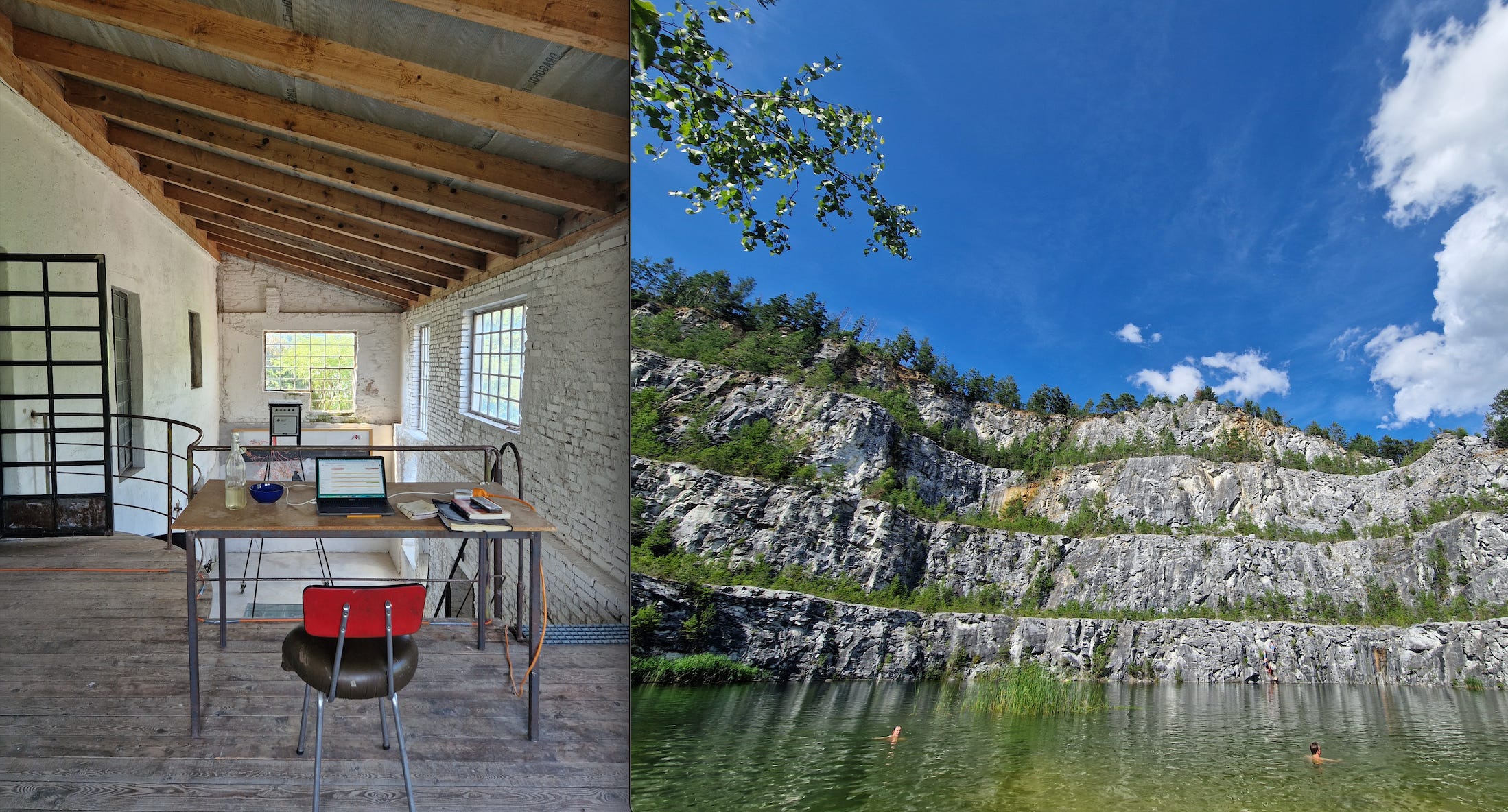
Following this, I immediately fled to ArtMill, a regenerative land project and artist residency in Czech Republic, serendipitously arranged months before the eviction. While amongst a group of sweet angels and collaborators on the site of a 500 year old flour mill in the picturesque Pilzen region, I recluded to my maringotka more than was socially acceptable, only to stare at the ceiling or pretend to read, worrying about what was next for me.
It was awkward to be depressed in such rural idyll, but I could not help it. I sent some desperate emails, journalled furiously yet nonsensically. I drank iron-rich water from their ground well and still slept like shit. Without judgement, the group included me in activities, like swimming in flooded quarries or tending to the permaculture garden. They fed me sumptuous meals of traditional recipes from homegrown veg. This was not a kindness I was used to performing for myself, a lesson to be learnt in persistantly offering compassion.
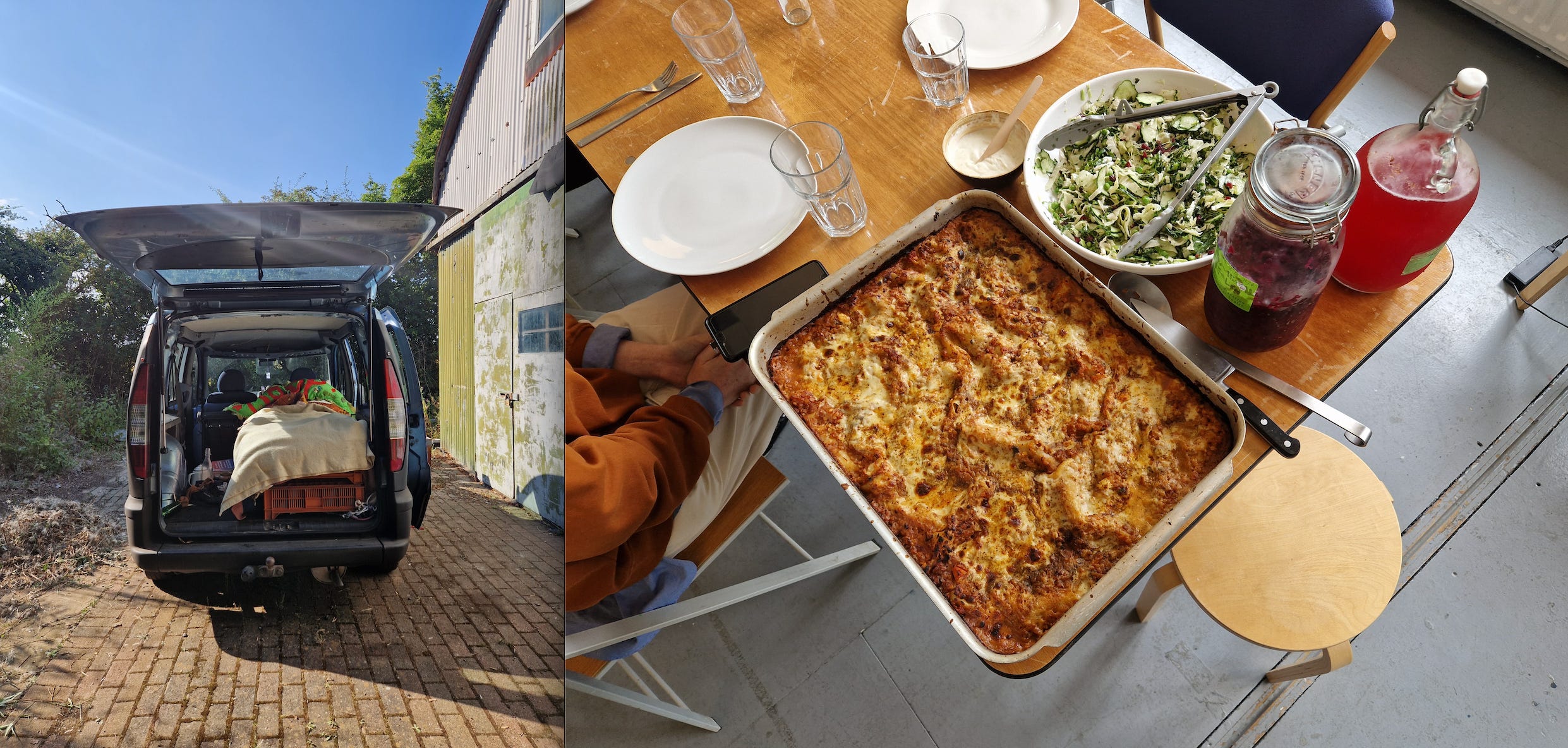
Back in England, I parked up in Doris the Doblo to perform the self-designated role of Ornamental Hermit at Wysing Arts Centre, made possible by the kind staff, and made bearable by access to a commercial kitchen I was allowed to commandeer. At least I could make ferments and cook nourishing food while everything else was spinning out. Most weeks I put on a free veggie lunch for all staff, studio holders and residents on site as a way of saying thank you.
Without proper housing or work for the forthcoming winter, my mental health was unstable. For the first time in my life I considered giving up my art ‘career’ and finding a ‘real job’. Whatever I was trying to do was cleary not working: I was technically homeless, storing my stuff in a friend’s empty gallery and sleeping in my van, at nearby residencies or with friends. Driving the two hundred mile round-trip every week to work my formerly local allotment for money and sleep in the van on a friend’s driveway was exciting in August and tiresome by September. The blow of lone travel only slightly softened by a boot full of organic tomatoes, courgettes, chives and chard harvested in the sun.
Rarely have I ever been able to plan my life more than a month in advance, give myself the grace of rest, spend frivolously without guilt. With money tight and work sporadic, every choice is agonising; one mis-step and it will all collapse. The precarity becomes strangulating, as it is for many freelancers. At that moment the delusion of choosing to live as an artist was wearing thin, disintegrating. The resource scarcity that has controlled many of the choices I have made in my life was closing in again. Desperately looking for full-time work, I toyed with going back into hospitality. Surely it wouldn’t be long before I was pulling pints on minimum wage again.
Two days after forlornly applying for a job as a worm farmer at an agroecological CIC in Scotland, a call came in. I had received a Visual Artist Award from the Paul Hamlyn Foundation. Having been informed of my nomination six month previously, I had put together my application between a borrowed Linux and free library computers, and carried on with my life without thinking much about it. I automatically assumed this was a courtesy call of rejection.
I broke down in tears in a crowded public place, incredulous and snivelling, thanking the voice on the end of the phone, then called my mum and cried more. Other than for my nearest, I had to keep the news quiet for two months until the public announcement; forget about it, pretend nothing happened. The messages of congratulations have been overwhelming, the institutional validation of my practice, too. I look at the list of previous winners and gulp cartoonishly.
In my car, where rumination is dangerous, I sporadically return to the sharp present. Sensations of pain, laughter and guilt force themselves out of the body in ugly ways while I try to concentrate on driving. Eruptions of tears, snot and curses. Slow to realise the discomfort of this new reality, and distraught to leave the familiarity of lack behind. Moving in stillness. People ask how I will spend the money and I say I won't, hardly.
For now I am back in Derbyshire, lodging with an anarchist I met at the community garden in their solar-powered house tucked away in the woods near the old Steiner School. Near the familiar forest walks, the winding Erewash canal and the National Cycle Route 67. I am metabolising things alone for a while, recovering from the communal obligations of living in an artist residency, of living my life to please others. I am making my world more manageable in the small warm room I helped strip, sand and paint the walls of. I have a studio within walking distance and a membership for the local pool. I am cooking, fermenting and cleaning for just one or two. I have to make specific plans to socialise and then travel to them. I am spending lots of time in bed. I am learning tai chi and stretching before bed.
I don’t know yet how my life will change. I am not naive enough to assume I know what happens tomorrow, let alone months down the line. All I know is that if I choose to I can continue to work with the same intensity and integrity as I have always strived to without risk of bankruptcy or houselessness. The question is will I want to? Do I have to? What if I decide not to, what if I let that go?
*
Good luck to all the artists nominated for this year’s awards. Here is a redacted version of my application text, as submitted to PHF in April 2024:
I am a visual artist, writer and landworker currently living and working at The Field, an experimental rural arts residency and co-living project near Ilkeston, East Midlands. I work open-endedly across many disciplines including sculpture, installation, cooking, foraging, publishing, workshops and community gardening. Though it has been labelled with ‘Social Practice’ before, I prefer ‘Living Practice’ as it requires daily maintenance of nourishing relationships with diverse human and more-than-human collaborators, eg housemates, employers, worms, plants and microbes.
Having swapped London for rural Derbyshire in 2021, I made a commitment to live with my practice - to embrace amateurism and prioritise creative thinking in community with others. This vision generates spaciousness to follow all my interests with the same intensity and sincerity and for outcomes to arise without force. In the climate crisis it's necessary for me to challenge and expand the received understanding of what constitutes an art material. In the spirit of degrowth most things I make get shared or eaten, composted or repurposed.
My practice is process-led and location responsive. I use slow observation of natural spaces, low-tech crafts with post-consumer waste, and preservation of edible abundances to battle the insanity of late capitalism. I turn expired beer into artisinal vinegar, recycle windows into outdoor rest spaces, make soil from organic debris. I relate to the term eco-critical in describing my work as both long-form research of natural systems under human domination and short-sighted curiosity (or desperation) for alternative futures.
Firstly, this award would relieve me from perpetual financial precarity and give me security should my housing situation need to change. I have been self-employed for several years, stubbornly centring my arts practice as the main mode for both income and creative expression. Freelance life is of course insecure and paid employment can be sporadic. Although not an easy balance to strike, I just about manage while retaining personal integrity and being selective about who I work with/for.
On paper I cannot afford to be an artist, so I am highly adaptable to my situation and lead a low-consumption lifestyle to exist purposefully. Simply, I would love to be able to plan my life more than a few months in advance, and to afford a few small luxuries like a car which is necessary for many of my projects.
This award would support me in continuing my self-initiated research and long-term ecological practice around rural arts communities, permaculture systems and food preservation. Since all my projects are defined by the urgency of climate crisis, much of my work is impermanent and time-sensitive so I cannot rely on future sales of artworks or gallery commissions. My practice is ostensibly about people and their relationship to land and the plants within, which manifests in ways that are hard to pin down or commodify.
Importantly, this award will allow me to continue working as an independent artist without the need for institutional representation. I have positioned myself on the periphery of the artworld so that I may use commissions to approach marginalised communities and practitioners with the intention of creating dialogue firmly footed in food justice and self-organising. From here I have been successfully building community with (inter)national artists and landworkers and sharing extensively through alternative currencies like labour exchange, favours and artswaps.
This has come at a critical time for me, personally and professionally. It goes without saying that this is a life-changing opportunity, and one that I had only day-dreamed of until now.
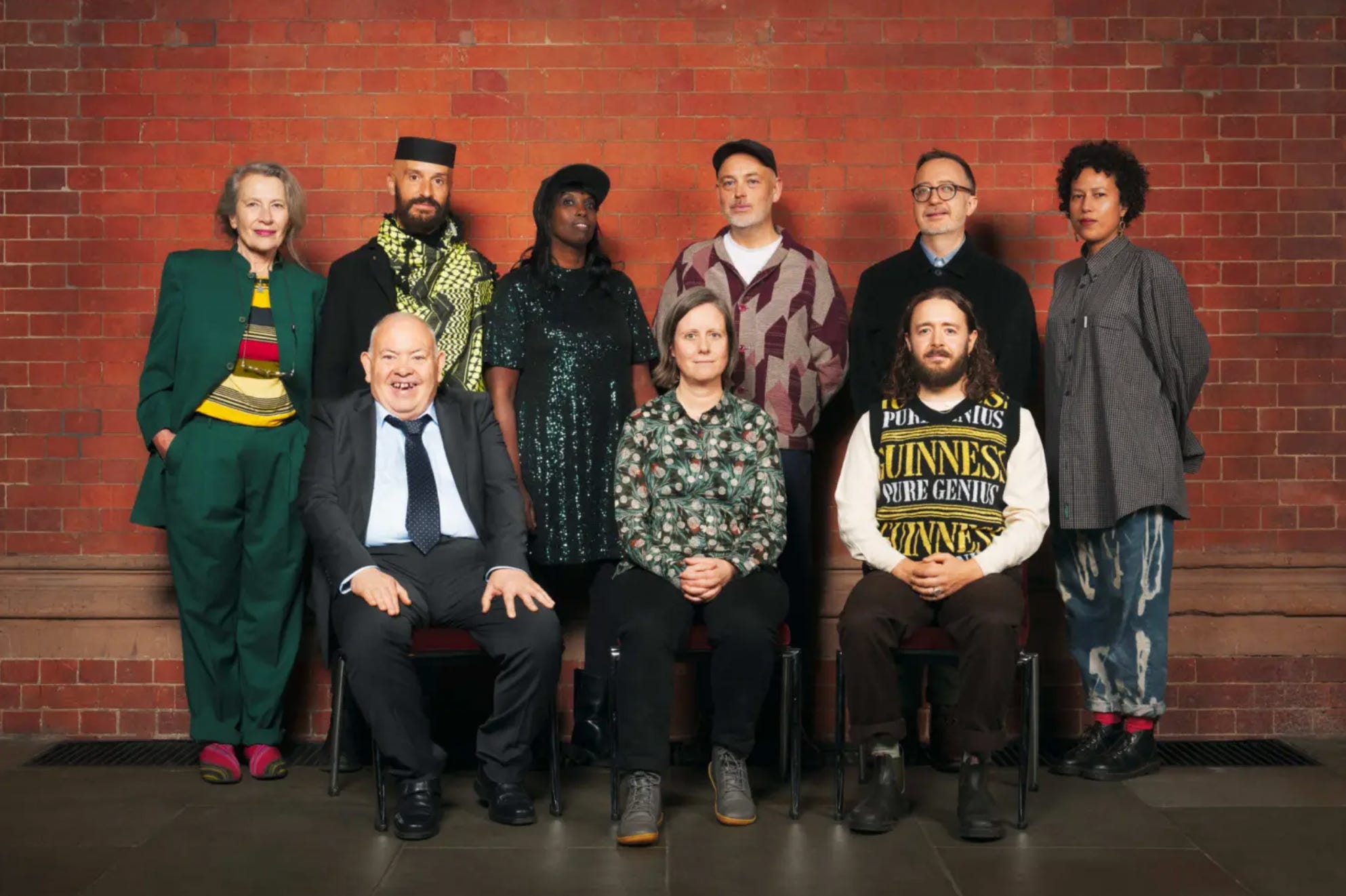
Awards for Artists 2024 recipients. Back row L R: Anne Bean, Mikhail Karikis, Grace Ndiritu, Aidan O’Rourke, Andrew Hamilton, Auclair. Front L R: Barry Anthony Finan, Rachel Musson, Sean Roy Parker. (Mark Sanders not present). Photo credit: Emile Holba
👍